Activities
ALTOM® 2025 online training courses in Audio-Psycho-Phonology — Tomatis Technique
In response to growing interest from professionals and parents wishing to study and discover the therapeutic legacy of Dr Tomatis, the Training department of ALTOMTOMATIS® has launched a set of online courses. They are designed to share his work and to introduce learners to the many facets of auditory function (hearing and listening) and its influence on learning, memory and attention — along with other aspects of the Tomatis technique.
The training can be taken from the comfort of home. It comprises 28 videos organised into five independent yet complementary courses, supplemented with PDF materials and the reading of two books.
_________________________________________________________________________________________________________________________
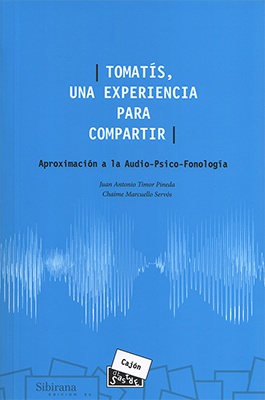
Tomatis, an experience to share
by Juan Antonio Timor Pineda and Chaime Marcuello Servós
Saturday 19 June 2021, 6:00 - 7:00 pm (Spanish time)
This free online presentation, given in Spanish, will be held over Zoom.
Speakers at the event, hosted by the F.I.A.P.E Federation:
- Chaime Marcuello Servós — co-author of the book
- Juan Antonio Timor Pineda — co-author of the book and vice-president of F.I.A.P.E
- Martha Mack — secretary of F.I.A.P.E
- Sandra Huguenin — secretary of Besson of Switzerland and F.I.A.P.E coordinator
_______________________________________________________________________________________________________________________________________
February 2019 meeting — Report
2-3 February 2019
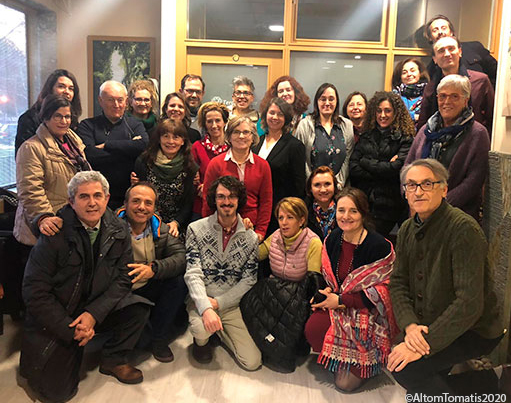
Hosted in Madrid by the Altom Association, Spain, a member of FIAPE. The two-day meeting drew participants from far afield — beginning with the keynote speaker, an Italian doctor of psychology based in Verona who had the privilege of working alongside Dr Tomatis during the 1980s.
We were also delighted to welcome Malgorzata Suzlej, FIAPE member and a psychologist in Poland with over twenty years of experience practising the Tomatis technique.
The refresher seminar gave the most experienced practitioners a chance to revisit and consolidate knowledge that time had eroded, while newer professionals could deepen their understanding.
Programme
- The laws of listening
- The Tomatis effect: psychological and anthropological perspectives
- Using the electronic ear to support foreign-language pronunciation, singing and instrumental performance
- Programmes and devices for postural difficulties and psychomotor disorders
- Other 2019 programmes for the electronic ear and technique
- The electronic ear and foreign languages — how the Tomatis method develops fine perception of a new language and improves verbal fluency
- Tomatis electronic-ear programmes for foreign languages — delay: posture and motor skills
- Precession and body image: technical and psychosomatic aspects
- How delay and precession influence pronunciation and psychomotor function
- Language as neural software: a tongue shapes posture, mimicry and much more
- Ethnolinguistic diversity: correct posture as a key to better foreign-language pronunciation
- How the mother tongue shapes musical composition and performance — using the electronic ear to improve a musician's instrumental playing
- Drawing on a composer's native language to refine the interpretation of their works
- The Caruso filter and others
- Working with electronic configurations (delay, precession, channel 1, channel 2)

_______________________________________________________________________________________________________________________________________
October 2017 meeting — Report
6-8 October 2017
This continuing-education meeting was organised in Madrid by the Altom Association, Spain, with the technical and voluntary support of the F.I.A.P.E International Federation and Besson of Switzerland.
The 30 APP professionals attending came from Canada, Belgium, Brazil, France, Poland and, of course, Spain (Madrid, Segovia, Almería, Granada, Barcelona, Galicia and beyond) — and their exchanges made the gathering particularly rich.
The principal guest was Paul Madaule, a psychology graduate and director of the Listening Centre in Toronto, Canada.
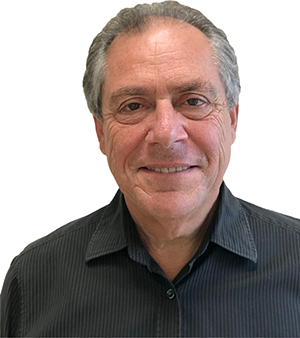
He introduced the Listening Identification System (SIE), also known as "the Wheel" — a therapeutic tool he uses in his clinic as a complement to Alfred Tomatis's Listening Test in patient assessment.
Programme
- What is listening?
- The SIE toolkit
- Listening profiles
- From listening profile to sound programme (programming)
- Case studies and discussion
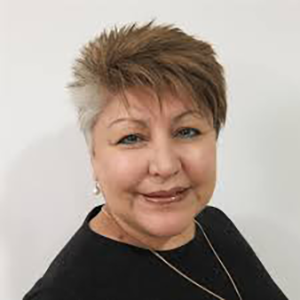
In the second part, Martha Mack — born in Australia, holder of degrees in Education and Psychology, director of the Listen and Learn Centre (Australia) and one of the four FIAPE committee members — presented several case studies tracing patients' progress through bone-conduction stimulation. She also introduced her latest method, designed to stimulate the corpus callosum: Listening Shadow™ Auditory Training (LSAT).
Programme
- Use of the Kios 4 (vibroacoustic stimulation system, Besson) with children showing developmental delay.
- Listening Shadow Auditory Training (LSAT) aims to foster inter-hemispheric discrimination and separation, sound localisation and attention focus. The device was developed specifically to stimulate the corpus callosum.
This device delivers inter-hemispheric stimulation that supports children with developmental difficulties, attention-deficit disorders (with or without hyperactivity), autism, dyslexia, and speech and language delays, among others. A live demonstration of the device accompanied the case-study presentations.
Clinical case
A case in which evaluation and treatment were carried out using a psycho-pedagogical approach supported by "auditory neuro-stimulation" therapy. Assessment relied on the Listening Test, a battery of auditory-processing tests, and a neuropsychological evaluation.
Together, these three instruments document the patient's progress academically, cognitively, neuromotorically and emotionally, as well as in their ability to process auditory information.
Research from the Listen and Learn Centre, Melbourne, Australia
1. Auditory Training for Children with Deficits in Auditory Processing: An Exploratory Study (2016), by Rachel Anne Pemberton — submitted in partial fulfilment of her Master's degree in Educational Psychology at the University of Melbourne (1 November 2016). The study examines the effect of Auditory Training™, using Christophe Besson's equipment, on 60 children with various difficulties including autism, dyslexia and ADD.
Statistical results show that, in these cases, auditory processing — that is, listening — improves after the programme (paper currently in preparation for publication).
2. Modulation of brain responses to auditory stimuli by the Mack-Besson Auditory Training Program: an event-related potential case study (2017). Mack, M.; Brown, T.; Mack, G.; Binnie, H.; Kropotov, J.D. This electrophysiological study, using QEEG (brain mapping) and event-related potentials, demonstrates that the auditory system of a child with dyslexia changes measurably after an auditory-training programme (paper currently in preparation for publication).
_______________________________________________________________________________________________________________________________________
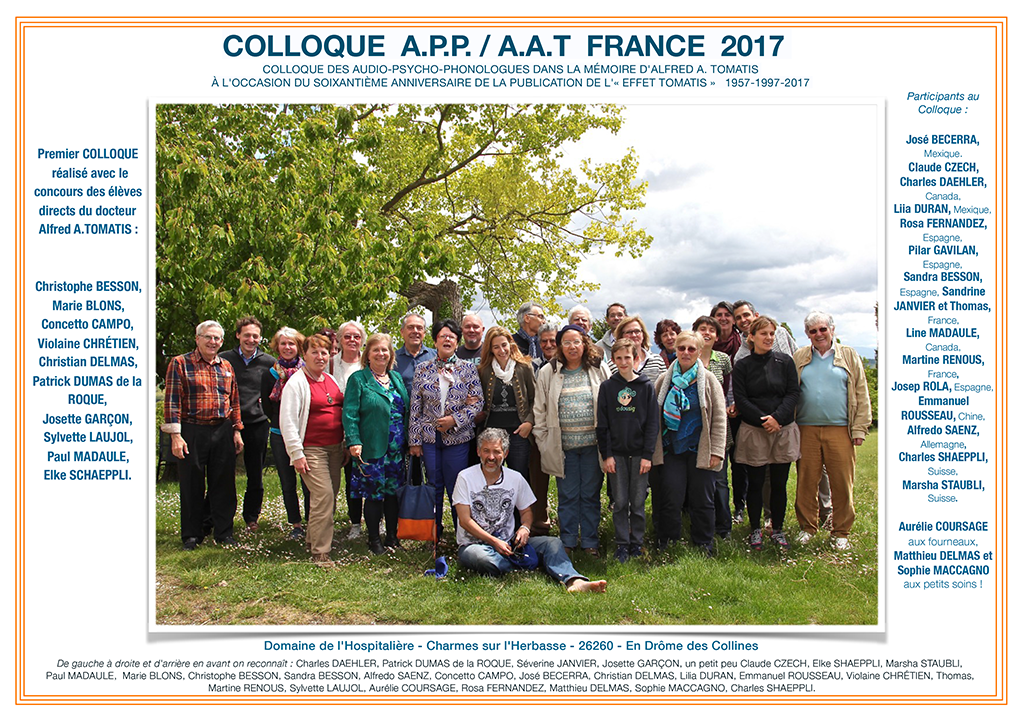
A.P.P. / A.A.T. Symposium — France 2017
6-7 May 2017
Marking the 60th anniversary of the "Tomatis effect"
_______________________________________________________________________________________________________________________________________
Book launch — Learn to Listen for Your Well-being: An Introduction to the Pedagogy of Listening, by Pierre Sollier
(Spanish title: Aprende a escuchar para tu bienestar — Introducción a la pedagogía de la escucha)
6 October 2016

Originally published in 2005 as Listening for Wellness, the work earned the IPPY Award for the best title in psychology.
On 6 October 2016 we were honoured to host the author for the launch and signing of the Spanish edition, Aprende a escuchar para tu bienestar, published by the Heriwald-Sial Pigmalion-Besson group under the auspices of the Spanish University Foundation in Madrid.
The event drew a large audience in person, and those unable to travel followed it via the live online stream provided for the occasion.
Speakers
- Christophe Besson — director of Besson of Switzerland
- Carmen Morante — secretary of the Altomtomatis Association
- Jacques-A. Schnieper — director of Heriwald Arts Studio
- Basilio Rodríguez Cañada — president of the Sial Pigmalión Editorial Group
- Pierre Sollier — author of the book
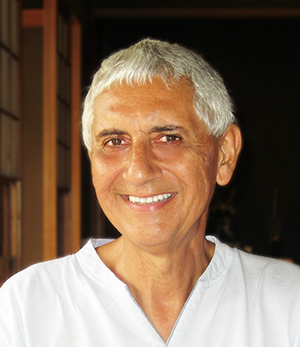
Pierre Sollier was born on 25 October 1948 in France. He taught French for ten years in the Paris region before moving to California in the 1980s, where his strong French accent became a serious obstacle to communicating in English. His life then took an unexpected turn when he walked through the door of Dr Alfred Tomatis's practice and tried the doctor's innovative method. Thanks to it, Sollier was able to shed his accent and develop the comprehension and diction of a foreign language — communicating fluently at last.
His enthusiasm for the Tomatis method led him to return to study and earn a degree in psychology from John F. Kennedy University in California. That degree, combined with his encounter with Dr Tomatis, prompted him to devote his career to relieving and resolving the difficulties of many patients.
In 1991, he opened the Mozart Centre in Lafayette, California, where he treated a large number of children and adults using the Alfred Tomatis method; in 1994, he moved to a larger practice to accommodate a growing Californian clientele. Sollier has authored several articles and co-translated the English edition of Tomatis's The Ear and the Voice. Since 2001, he has lived in Oaxaca, in southern Mexico, where he devotes himself to writing and to voluntary work.
Learn to Listen for Your Well-being — An Introduction to the Pedagogy of Listening
Sollier's book offers a clear, accessible and complete synthesis of Alfred Tomatis's work. Far more than a mere introduction, it is a masterly account of his mentor's research. Reading it makes plain why the book received the IPPY Award in 2005 as the best title in psychology. The method that Alfred Tomatis presents, the fruit of many years of research, is a precise gymnastics for the hammer and stirrup bones of the ear. This "fine-tuning" produces beneficial effects on bodily and somatic well-being. The methodology was recently and concisely described in a chapter of the latest book by the renowned Canadian psychiatrist Norman Doidge, The Brain's Way of Healing, which surveys the lives and work of the pioneers of neuroplasticity.